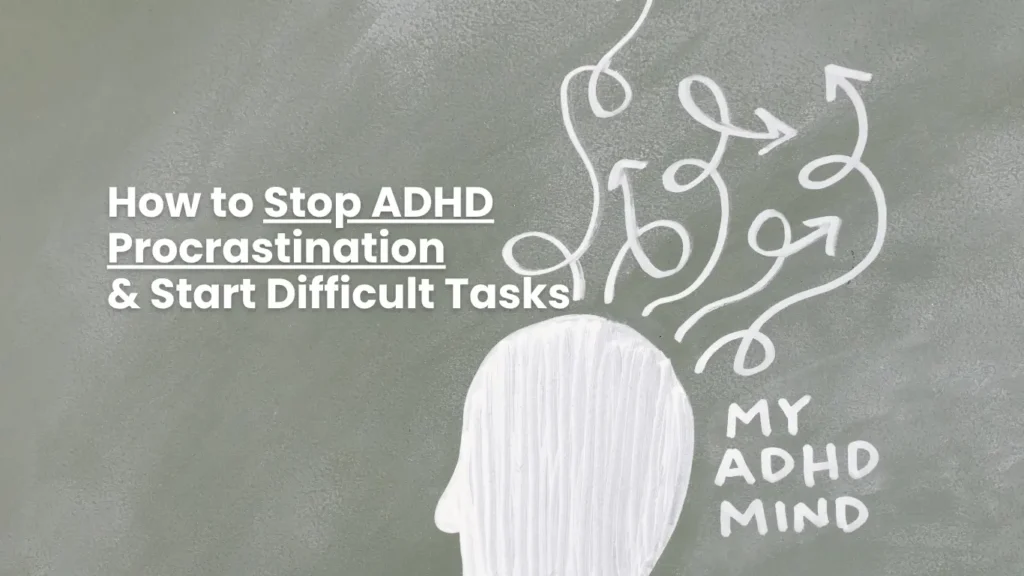
How to Start Difficult Tasks When ADHD Makes You Procrastinate
ADHD and procrastination can become closely connected when a person knows what needs to be done but struggles to start. A difficult task may feel too large, too boring, too complicated, or too far away from its eventual reward. Instead of starting, you may check your phone, clean something else, switch to an easier task, or keep telling yourself you will do it later. Research has found an association between ADHD symptoms and procrastination, particularly around difficulties with motivation, delayed rewards, and adjusting goals when a task feels difficult.
Procrastination is not itself a diagnostic symptom of ADHD. However, difficulties with attention, organization, time management, self-regulation, and task initiation can make it harder to begin and complete tasks consistently. The solution is not simply to tell yourself to “stop procrastinating.” A more useful approach is to make the starting point clearer, smaller, and easier to reach.
If ADHD makes it difficult to start hard tasks, focus on the starting process rather than the entire project. Define the first physical action, make the task smaller without losing the goal, create an external cue to begin, remove easy distractions, and work toward the next checkpoint instead of thinking about the entire finish line.
Why Is It So Hard to Start Difficult Tasks With ADHD?
Starting a task requires more than knowing what needs to be done. You have to organize the task, decide where to begin, estimate how long it may take, manage distractions, and stay engaged long enough to make progress.
For a person living with ADHD, these demands can make task initiation particularly difficult. A task may be especially hard to start when it is repetitive, has a delayed reward, contains several steps, feels uncertain, or creates frustration or anxiety.
This is why someone can genuinely want to complete a task and still find themselves avoiding it. The problem is not a lack of understanding of the goal. The problem is getting from knowing what to do to actually starting it.
A Five-Step Plan for ADHD People to Start Hard Tasks
An ADHD-friendly morning routine should be realistic, structured, and flexible. It should account for the areas where you typically lose time or become distracted instead of assuming that you will simply remember everything and stay focused.
1. Define the First Physical Action
People with ADHD may know what they need to accomplish but still struggle to turn a large, undefined task into a clear starting point. Instead of writing down only the goal, define the first physical or observable action you need to take. The clearer the starting action, the less work your brain has to do to figure out where to begin.
“Work on my presentation,” “do my taxes,” and “clean the kitchen” identify the goals, but they do not tell you what to do first. Turn each goal into a specific action:
- Instead of “work on my presentation,” open the presentation and write the title of the first slide.
- Instead of “do my taxes,” open your tax documents and place the first form you need in front of you.
- Instead of “clean the kitchen,” put the dishes from the counter into the dishwasher.
The first action should be something you can physically see yourself doing. It should move the task forward rather than simply prepare you to prepare. This can be particularly useful when ADHD-related executive-function difficulties make large or undefined tasks harder to initiate. You are not trying to finish the task in your head, you are deciding exactly what you will do first.
2. Make the Task Smaller Without Losing the Goal
A difficult task can remain untouched when the entire project feels too large to hold in your head at once. Breaking it into smaller, meaningful pieces reduces the amount of planning required at any one time and gives you clearer points of progress.
For example, “finish the report” is a goal, but it is not one useful action. You might break the project into reviewing your notes, outlining the main points, drafting the introduction, writing the main sections, and editing the completed draft.
The goal should be to make the project concrete enough that you can see what comes next, and not to turn every project into a checklist of dozens of tiny actions. Once the larger task is divided into manageable pieces, return to the first physical action and begin there.
3. Give Yourself an External Starting Cue
Waiting until you feel ready to start can keep a difficult task on your list all day. An external cue gives you a specific signal for when the task begins, so starting does not depend entirely on remembering, deciding, or feeling motivated in that moment.
Connect the task to something concrete, like a particular time, place, existing routine, or alarm. For example, you might decide that after breakfast you will sit at your desk and work on the report for 20 minutes. You could also set an alarm labeled: “9:00 — Open report and start Section 1.”
The cue can also be connected to a place. Working on an important project only at your desk, for example, creates a consistent environmental signal that it is time to begin. The purpose should be: replace “I should start sometime” with “this is when I start.”
4. Remove the Easiest Escape Routes
When a difficult task is competing with immediately available distractions, switching away from the task can become much easier than staying with it. Your environment can therefore either support task initiation or make avoidance effortless. Before starting, remove the distractions you are most likely to reach for. Put your phone out of reach, close unrelated browser tabs, silence unnecessary notifications, and keep only the materials you need for the task in front of you.
If another thought or task comes to mind, write it down rather than immediately switching to it. A simple “distraction list” gives you somewhere to park the thought without allowing it to interrupt the task. You do not need a perfectly distraction-free environment. Aim to make the easiest alternative slightly harder to reach.
5. Work Toward the Next Checkpoint, Not the Finish Line
One reason difficult tasks remain untouched is that the finish line can feel too far away. When the only objective is “finish the project,” the amount of work between where you are and where you want to be can make starting feel harder. Instead, decide what the next checkpoint will be.
Your checkpoint coule be finishing a first draft, working on a report for 30 minutes, completing the first two problems, writing an introduction, or reviewing the first section. Once you reach the checkpoint, decide what happens next. You can continue if you have momentum, take a planned break, or stop and schedule the next work session. The important part is that you are working toward the next defined point rather than carrying the entire project in your mind while you work.
The 5-Step ADHD Task-Starting Plan
1. Define the first action: Turn the goal into one physical, observable action.
2. Make the task smaller: Break the project into manageable pieces without losing the overall goal.
3. Create an external cue: Use a time, place, routine, or alarm to signal when to begin.
4. Remove easy distractions: Make it harder to escape into your phone, tabs, or unrelated tasks.
5. Work to the next checkpoint: Focus on the next defined stopping point instead of the entire finish line.
What Should You Do When You Keep Avoiding the Same Task?
If you repeatedly postpone the same task, look at what makes that particular task difficult to start rather than simply trying harder. If the task is too large, break it into meaningful pieces. If you do not know where to begin, define the first physical action. If the task feels boring, add structure or stimulation. If you are worried about doing it incorrectly, separate starting from doing it perfectly. If your environment creates constant distractions, change the environment before you begin.
You can also use a timer when you tend to underestimate how long a task will take. A defined work period gives the task a clear beginning and end, making it easier to approach than an open-ended instruction to “work on it.” The objective should be to identify the barrier and change the process around the task.
What If You Still Can’t Get Started After Breaking the Task Down?
Breaking a task into smaller pieces can help, but it does not solve every problem with task initiation. If difficulty starting and completing tasks happens repeatedly across different areas of life, look beyond the individual task. Persistent problems with organization, time management, attention, task switching, deadlines, or completing responsibilities may be worth discussing with a qualified mental health professional.
ADHD can contribute to these difficulties, but it is not the only possible explanation. Anxiety, depression, sleep problems, stress, and other factors can also affect concentration, motivation, and the ability to initiate tasks. An evaluation can help determine what may be contributing to the pattern instead of assuming that procrastination is simply a matter of discipline.
Can ADHD Treatment Help With Procrastination?
Yes treatment from ADHD specialist Dr. Imran Akram, MD in Reston, Virginia can help overcome procrastination. Difficulty with procrastination and task initiation can be addressed as part of ADHD treatment, particularly when these problems are connected to broader difficulties with organization, planning, attention, behavioral activation, or self-regulation. Research on cognitive behavioral therapy (CBT) for adults with ADHD has specifically included procrastination and related task-management difficulties as treatment targets.
Treatment is individualized. Depending on the person’s diagnosis, symptoms, medical history, and goals, a psychiatrist may consider medication, behavioral strategies, psychotherapy such as CBT, or a combination of approaches. The treatment aims to address the underlying difficulties that interfere with daily responsibilities and functioning.
A Better Way to Think About ADHD Procrastination
Instead of asking why I can’t do this, try asking what is making this task difficult to start, and what can you change. Maybe the task is too large. Maybe the first step is unclear. Maybe the reward feels too far away. Maybe the environment makes distraction easier. Maybe the task creates anxiety because you are worried about making a mistake. Once you identify the barrier, you can change the process around the task. And if this pattern keeps appearing across work, school, household responsibilities, relationships, or other areas of daily life, it may be worth discussing your symptoms with an ADHD specialist or psychiatrist. A professional evaluation can help determine whether ADHD or another condition may be contributing to persistent difficulties with attention, organization, time management, and task initiation.
At Comprehensive Psychiatry in Reston, Virginia, Dr. Imran Akram, MD provides ADHD evaluations and individualized treatment for adults. If difficulty starting, organizing, or completing tasks has become a persistent pattern, scheduling a psychiatric evaluation can be a useful next step toward understanding what is causing it and determining whether treatment may help.
Comprehensive Psychiatry
1800 Town Center Dr, Suite 420 Reston, VA 20190
Phone: (703) 574-6311
Current fees, appointment availability, and payment policies should be confirmed directly with the practice before scheduling.